YouTube crossed $60 billion in total annual revenue in 2025.
That's 33% more than Netflix.
And YouTube pays $0 for content. Creators supply it for free.
Below you'll find 150+ verified stats on YouTube's growth, creator income, algorithm behavior, and ad performance. Every number comes with a clear takeaway so you know what to do with it.
Let's get into it.
The 15 numbers that tell the whole story
Before we get into the full data, here are the stats that matter most.
YouTube hit $60 billion in total revenue in 2025. That's more than Netflix ($45.6B). And YouTube spends nothing on content.
Just 6,600 creators qualify as "Creator TV" channels in the US. Together they generated 136 billion views and 26 billion hours watched in 2025. More than ESPN. More than Hulu.
YouTube holds 12.5% of all US TV viewing. Netflix holds 9%. YouTube is already the biggest streaming service in America.
Shorts hit 200 billion daily views in 2026. That's up from 30 billion in 2021. TikTok didn't kill YouTube. YouTube ate TikTok's lunch.
The median YouTube creator earns $3,000 a year. The top 10% take home 62% of all ad revenue. The creator economy sounds glamorous. The math is brutal.
A personal finance video earns up to 25x more per view than a gaming video. Same platform. Same algorithm. Completely different financial reality.
India has nearly 500 million YouTube users and an average CPM of $0.74. The US has half as many users and a CPM of $14.67. Volume does not equal income.
Smart TVs are 16% of views but drive 42% of watch time. If you're optimizing only for mobile, you're leaving half your watch hours on the table.
Videos over 20 minutes make up 57% of total global watch time. Long-form isn't dead. It's dominant.
YouTube's average session is 7 minutes 37 seconds. TikTok's is 5 minutes 52 seconds. Facebook's is 3 minutes 44 seconds.
93% of marketers report positive ROI from YouTube campaigns. The highest figure ever recorded.
YouTube delivers 109% higher ROI than linear TV advertising. And TV still gets billions in ad spend every year.
Average views per video jumped 76% between 2024 and 2025. Engagement rate dropped 37%. That's not bad news. I'll explain why below.
AI-generated content faces strict demonetization rules from March 2026. Authenticity now has a dollar value.
YouTube is on track to hit 3 billion monthly active users by 2027. Without ever operating in China.
Total YouTube revenue, including subscriptions.
Estimated monthly active users worldwide.
Average Shorts views generated each day.
Share of all television viewing in the United States.
User growth stats
Monthly active users
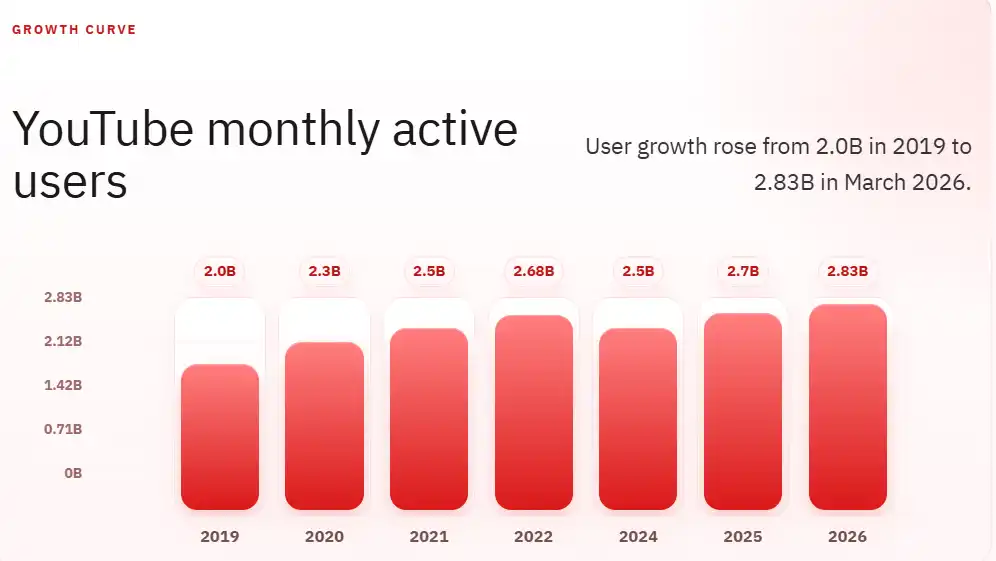
YouTube hit 2.83 billion monthly active users in March 2026.
That's roughly 46% of every internet user on the planet.
About 30% of every human alive.
So if you're asking "how many YouTube users are there," the clean answer is this: YouTube has about 2.83 billion monthly active users in 2026 with older conservative estimates around 2.58 billion depending on how the source defines an active user.
Here's the growth curve:
| Year | Monthly Active Users | YoY Change |
|---|---|---|
| 2026 (March est.) | 2.83 billion | +4.8% |
| 2025 | 2.58–2.70 billion | +0.74–3.2% |
| 2024 | 2.50 billion | +8.7% |
| 2022 | 2.68 billion | - |
| 2021 | 2.50 billion | +8.6% |
| 2020 | 2.30 billion | +15.0% |
| 2019 | 2.00 billion | +11.1% |
Growth is slowing. That's not a red flag.
Here's why: they've already captured almost every available user in every market where the platform operates. Slower growth at 2.83 billion is a VERY different problem than losing users.
YouTube isn't competing with social platforms anymore. It's competing with television, sleep, and human waking hours.
Daily active users
On any given day, at least 122 million logged-in users open YouTube on purpose.
Widen that to include embedded views, smart TV watching, and mobile browsers. The daily number climbs to 340 million people.
That means YouTube daily active users are not a single fixed number. The logged-in app/web figure is the stricter estimate. The broader daily reach number includes people watching through TVs, embeds, and browsers where user identity is harder to count.
Those 340 million people collectively watch over 1 billion hours of video every single day.
And creators feed that machine with 500 hours of new video every minute. That's 720,000 hours of new content indexed daily.
Nobody has watched all of YouTube. Not even YouTube's algorithm.
Where YouTube users actually live
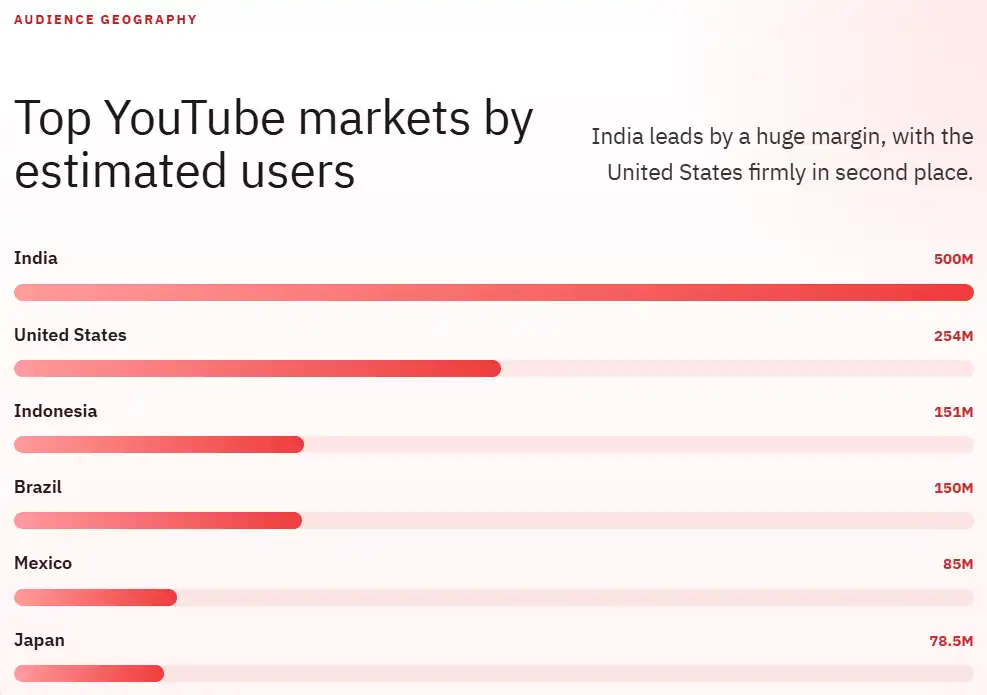
India is the biggest YouTube market by a wide margin:
| Rank | Country | Estimated Users |
|---|---|---|
| 1 | India | 491–500 million |
| 2 | United States | 253–254 million |
| 3 | Indonesia | 151 million |
| 4 | Brazil | 144–150 million |
| 5 | Mexico | 85 million |
| 6 | Japan | 78.5 million |
| 7 | Germany | 64.7 million |
| 8 | Vietnam | 62.1 million |
| 9 | Philippines | 59.6 million |
| 10 | Turkey | 57.9 million |
| 11 | United Kingdom | 55.5 million |
Here's the thing:
95% of YouTube content consumed in India is in regional languages. Not Hindi. Regional. Tamil, Telugu, Bengali, Marathi, Kannada.
And 665 million people in rural India still don't have internet access.
If you're making English content and chasing Indian traffic for ad revenue, the numbers don't work. India's CPM is $0.74.
But if you need scale and regional reach, no other platform comes close.
The markets YouTube can't enter
YouTube is blocked in China, North Korea, Iran, Turkmenistan, South Sudan, and Eritrea.
China alone has over 1 billion internet users.
YouTube built a 2.83 billion user base without ever entering the world's largest national market. Worth thinking about.
Demographics
Age breakdown
The biggest age group on YouTube is 25 to 34. They make up about 21.3% to 21.7% of global users.
| Age Group | Share of Global Users |
|---|---|
| 18–24 | 14.7–15.8% |
| 25–34 | 21.3–21.7% |
| 35–44 | 18.5–18.7% |
| 45–54 | 14.0–14.3% |
| 55–64 | 9.9–10.4% |
| 65+ | 9.5–10.0% |
The 65+ group is nearly 10% of users. Older audiences are moving from cable TV to YouTube faster than most marketers have noticed.
In the US specifically: 91% of Gen Z uses YouTube. 90% of Millennials. 83% of Gen X. 69% of Baby Boomers. See YouTube channel statistics to understand what these demographics are watching.
This is not a platform for young people. It's a platform for everyone.
Now:
One underserved gap worth noting. The 45 to 64 demographic. High CPM (they have disposable income), limited quality content options, and strong loyalty once you earn it.
One of the clearest content opportunities on the platform right now.
Gender split
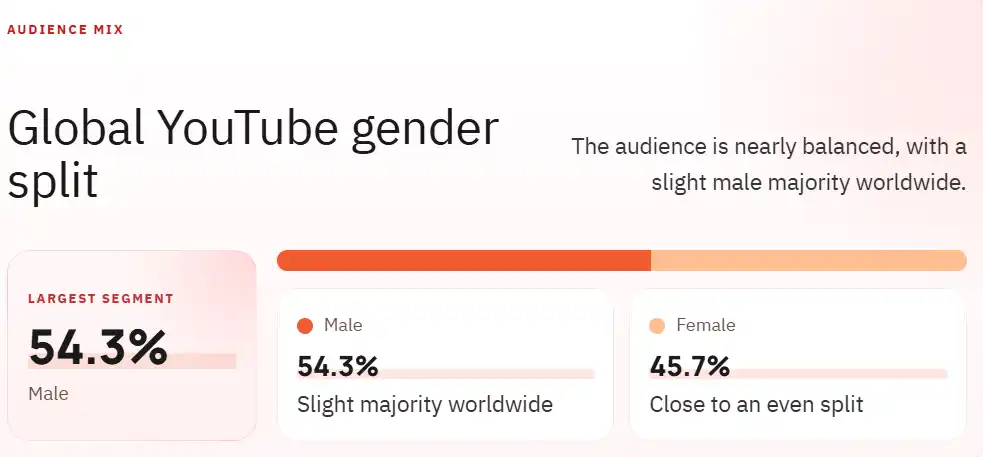
Globally, YouTube skews slightly male: 53% to 54.3% male, 45.7% to 47% female.
But in the United States, women outnumber men: 51.2% female vs 48.8% male. In the UK, the split is exactly 50/50.
The global male skew comes almost entirely from South Asian and African markets, where men own more smartphones than women. In developed economies with equal digital access, the gap disappears.
How people watch
Daily watch time
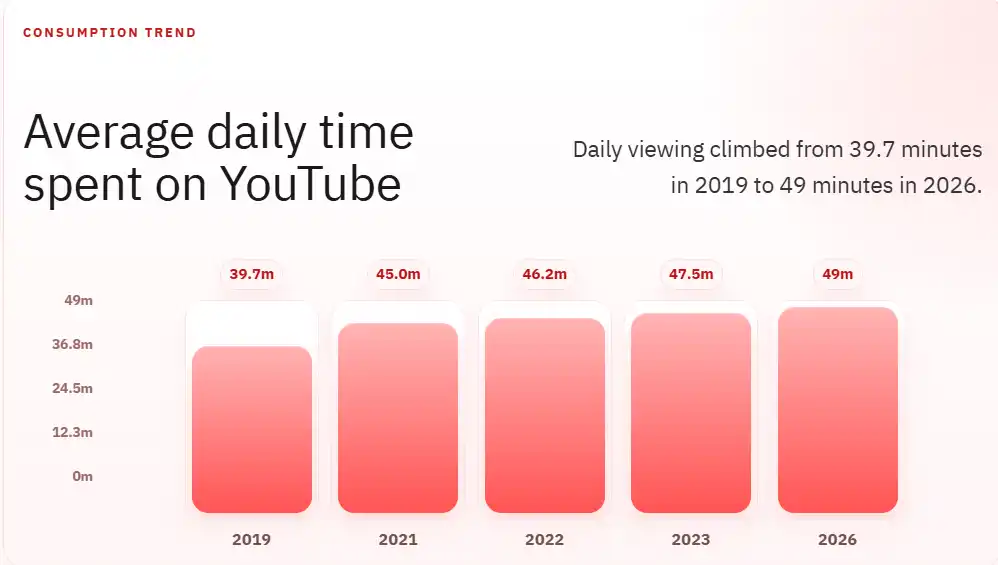
Global users spend an average of 48.7 to 49 minutes per day on YouTube in 2026.
| Year | Avg. Daily Time Spent |
|---|---|
| 2026 | 48.7–49 minutes |
| 2023 | 47.5 minutes |
| 2022 | 46.2 minutes |
| 2021 | 45.0 minutes |
| 2019 | 39.7 minutes |
That's a nearly 25% increase in daily watch time over seven years. Total consumption runs over 1 billion hours watched daily.
US users average 35 to 37 minutes per day. Lower than the global average. But more than compensated by premium ad rates.
Session duration
YouTube's average session: 7 minutes and 37 seconds.
TikTok: 5 minutes 52 seconds. Facebook: 3 minutes 44 seconds.
Here's why that matters:
YouTube users don't scroll and bounce. They sit and watch. That's why mid-roll ads generate more revenue per impression than any feed-based ad format on competing platforms.
Device breakdown
Mobile accounts for 69% to 70% of all YouTube views. In emerging markets, mobile drives 87% to 90% of all web visits.
Smart TVs are only 16% of total views. But they drive 42% of all watch time.
TV viewers watch longer. They're more passive. Less likely to skip. Worth more to advertisers through Connected TV formats.
In May 2025, YouTube accounted for 12.5% of all US television viewing. The highest share ever recorded for a single streaming service. Netflix held 9%.
YouTube is not a social media app. It's the most-watched television channel in America.
Content trends
Long-form still dominates
Videos over 20 minutes make up 57.24% of total global watch time.
Short-form content is exploding in view count. But the majority of time people spend on YouTube is watching long videos.
Here's how to think about it:
Shorts win you reach. Long-form builds your watch time. Creators who post only Shorts are winning views but losing the watch time the algorithm actually rewards.
What's working in 2026
Long-form tutorials and education are the strongest performers right now. High CPM, high retention, CTV-friendly.
Specifically:
- Personal finance and investing content earns $15 to $50 CPM
- Tech and SaaS reviews hit $10 to $30 CPM
- Short-form discovery content that drives subscriptions is holding strong
What's NOT working:
- AI-generated bulk content is being demonetized as of March 2026
- Gaming without a strong personality earns $2 to $5 CPM
- Pure reaction content with no original angle gets flagged as low-effort
- Entertainment vlogs in saturated niches sit at $6 to $12 CPM with brutal competition
The engagement paradox
Between 2024 and 2025, average views per video jumped 76%. From 389.9 to 687.2 views per video.
At the same time, engagement rate dropped 37%. From 3.73% to 2.34%.
Most people read this as bad news.
It isn't.
Here's why:
The algorithm got better at pushing content to passive CTV audiences. Someone watching YouTube on their TV at 10pm isn't grabbing the remote to leave a comment. But they're watching longer and seeing more ads.
Raw comment volume actually increased 38%. The engaged community is still there. It's just a smaller percentage of a MUCH larger total audience.
So what should you track instead?
Total watch time, absolute comment count, CTR, and subscriber conversion from views.
YouTube Shorts: the full picture
The numbers
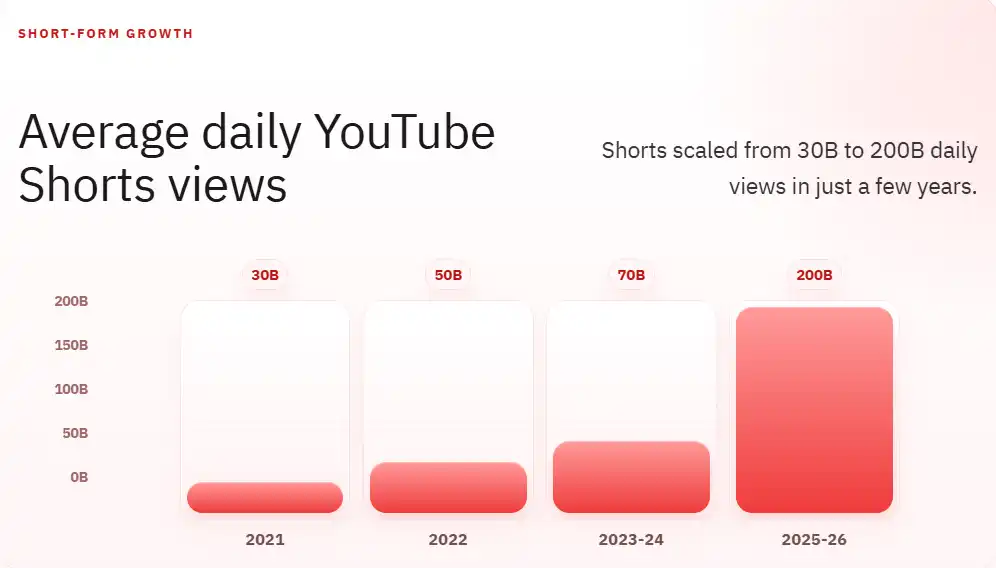
Daily Shorts views hit 200 billion in 2026. Up from 30 billion in 2021.
| Year | Average Daily Shorts Views |
|---|---|
| 2021 | 30 billion |
| 2022 | 50 billion |
| 2023–2024 | 70 billion |
| 2025–2026 | 200 billion |
Nearly 3x growth in two years. (Pretty wild, right?)
There are now 2 billion monthly active Shorts users globally. The US alone had 175.1 million Shorts users in 2025, projected to reach 184.6 million in 2026.
The algorithmic sweet spot: 20 to 40 seconds. Videos with a 50 to 60 second average view duration average 4.1 million views. Compare that to 100,000 views for 10 to 20 second videos.
The real purpose of Shorts
Shorts are not a revenue channel. They're a discovery channel.
The average Shorts creator earns $0.01 to $0.06 per 1,000 views. That's not income. That's exposure.
Here's the real play:
A viewer finds a 30-second clip, subscribes, then watches a 30-minute high-CPM video on the same channel. YouTube designed Shorts to function as a top-of-funnel mechanism that feeds the main algorithm.
59% of Gen Z uses Shorts to discover content before seeking out longer videos (Google NewFronts 2026).
The Short is the hook. The long-form video is where the money is.
Revenue and monetization
Platform revenue
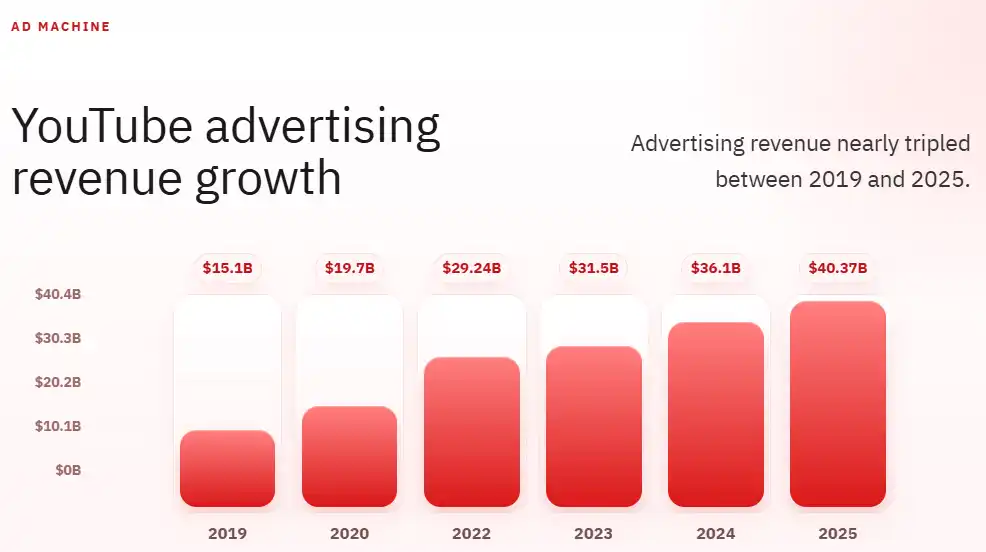
| Year | Advertising Revenue |
|---|---|
| 2025 | $40.35–$40.37 billion |
| 2024 | $36.10 billion |
| 2023 | $31.50 billion |
| 2022 | $29.24 billion |
| 2020 | $19.70 billion |
| 2019 | $15.10 billion |
Total revenue including subscriptions crossed $60 billion in 2025. YouTube Premium, YouTube Music, and YouTube TV contributed an estimated $19 to $20 billion of that.
Premium subscribers hit 125 million globally by early 2025.
And here's the kicker:
YouTube TV crossed 9.4 to 10 million US subscribers. That makes it the biggest streaming pay-TV provider in the US. Hulu + Live TV has 4.4 million. Sling TV has 2 million.
YouTube is becoming the default cable replacement. Most cable companies haven't figured out how to respond.
CPM by country
This is the data that changes how you think about audience targeting.
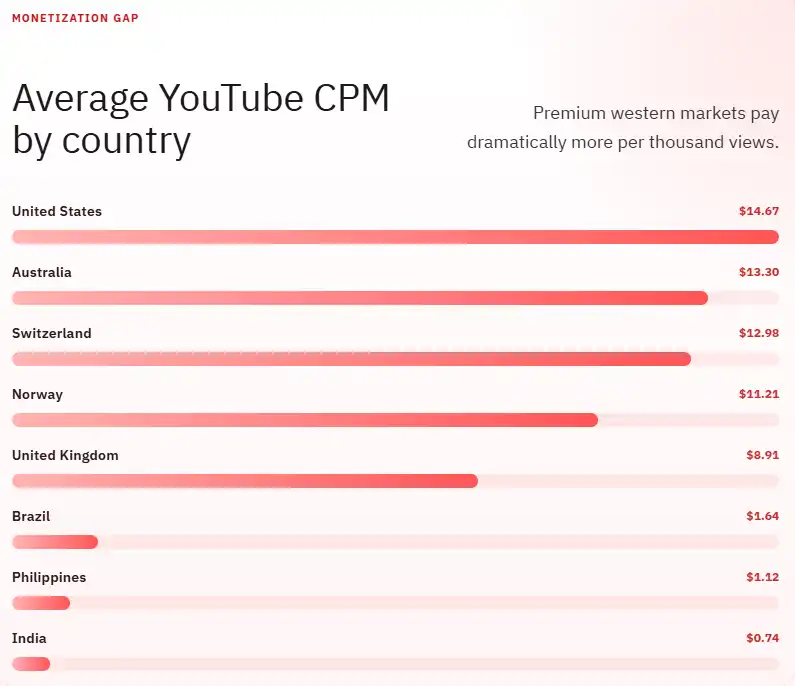
| Country | Average CPM |
|---|---|
| United States | $14.67 |
| Australia | $13.30 |
| Switzerland | $12.98 |
| Norway | $11.21 |
| United Kingdom | $8.91 |
| Brazil | $1.64 |
| Philippines | $1.12 |
| India | $0.74 |
A US-based audience is worth roughly 20x an Indian audience per thousand views.
Here's the thing:
A creator targeting American searchers (even from Southeast Asia) earns American ad rates. Creators in Eastern Europe and Southeast Asia produce English content with no regional cultural markers specifically to capture Western CPMs.
Digital arbitrage. It's real.
CPM and RPM by niche
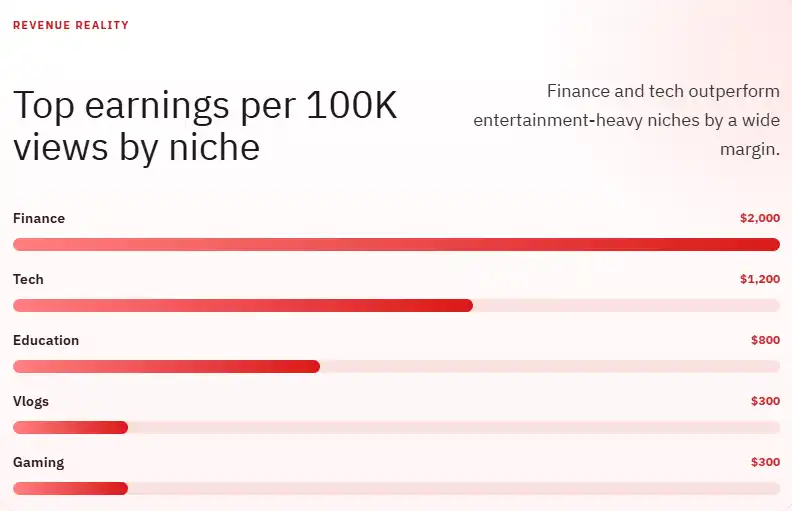
This table matters more than almost anything else in this report if you're picking a niche.
| Content Niche | CPM Range | Typical RPM | Earnings per 100K Views |
|---|---|---|---|
| Personal finance and investing | $15–$50 | $5.00+ | $500–$2,000 |
| Technology and SaaS | $10–$30 | $3.00–$4.00 | $300–$1,200 |
| Education and e-learning | $9–$25 | $2.00 | $200–$800 |
| Entertainment and vlogs | $6–$12 | $1.00 | $100–$300 |
| Gaming | $2–$5 | $0.80 | $80–$300 |
A personal finance channel can earn 25x more per view than a gaming channel.
If you're choosing between those two niches right now with revenue as your goal, the data has already made the decision for you.
The reality of creator income
There are roughly 110 million YouTube creators as of 2026.
Only 3 million are monetized through the Partner Program. Only 32,300 channels have crossed 1 million subscribers. That's 0.028% of all channels.
The income split:
- Top 10% of creators earn 62% of all ad revenue (up from 53% in 2023)
- Median annual creator earnings: $3,000
- 73% of creators earn below $30,000 per year
- Only 4% earn more than $100,000 annually
YouTube's Partner Program split is 55% to creators, 45% to YouTube. To earn $1,000, a creator typically needs roughly 500,000 views.
A modest $5,000 per month requires around 2 million monetized views monthly.
Not impossible. But not what the success stories tell you.
The creator economy is real. The income distribution is SUPER unequal.
How the algorithm works
The core model
YouTube's algorithm is a retention-first recommendation engine. It doesn't reward upload frequency. It rewards watch time.
Four variables drive everything:
- Click-through rate: Did people click on the thumbnail?
- Average view duration: How much of the video did they watch?
- Session time: Did your video lead to more YouTube watching?
- Satisfaction signals: Likes, shares, comments, survey responses.
Here's the part most people miss:
The algorithm optimizes for session time on the platform, not just watch time on your video. A video that keeps someone on YouTube for 3 hours after watching it gets pushed harder than a video with high watch time but high exit rates.
CTR benchmarks
| Niche | Average CTR | Strong CTR |
|---|---|---|
| Personal finance | 4–8% | 10%+ |
| Tech reviews | 5–9% | 11%+ |
| Education | 4–7% | 9%+ |
| Entertainment/vlog | 3–6% | 8%+ |
| Gaming | 4–8% | 10%+ |
| News/commentary | 2–5% | 7%+ |
The first 24 to 48 hours after publishing are critical. YouTube tests your video on a small initial audience. If that sample clicks and watches, the video gets pushed wider.
If it doesn't, it gets suppressed. Regardless of quality.
Retention benchmarks
| Video Length | Average Retention | Strong Retention |
|---|---|---|
| Under 5 minutes | 60–70% | 80%+ |
| 5–10 minutes | 45–55% | 65%+ |
| 10–20 minutes | 35–45% | 55%+ |
| 20–40 minutes | 25–35% | 45%+ |
| 40+ minutes | 20–30% | 40%+ |
The first 30 seconds determine whether someone stays or leaves. Videos with strong hooks in the first 15 seconds see dramatically higher overall retention.
Not all watch time is equal
CTV watch time carries more weight per minute than mobile watch time in YouTube's monetization calculations.
Smart TV viewers watch longer. Convert better on ads. Generate higher CPMs.
A channel with 10 million views mostly from CTV will typically earn more than a channel with 15 million views mostly from mobile.
Build for the TV audience if you want to maximize revenue per view.
Why people click (and why they stay)
The click decision
People click on YouTube videos for one of three reasons:
- Curiosity gap. The thumbnail hints at information they don't have.
- Personal relevance. It directly addresses a problem they have right now.
- Social proof. The view count, channel name, or creator face signals trust.
The thumbnail does more work than the title. Eye-tracking research shows the image is processed before the text. A great title with a bad thumbnail loses to a bad title with a great thumbnail.
Every time.
The first 30 seconds
YouTube's own data shows significant viewer drop-off in the first 30 seconds of most videos.
If someone doesn't get a signal of value in the first 15 to 30 seconds, they leave. They don't skip around. They just leave.
Here's the structure that works:
- Hook (0 to 30 seconds): State exactly what value they'll get
- Setup (30 to 90 seconds): Establish the problem and your credibility
- Core content: Deliver what you promised
- Pattern interrupts every 2 to 3 minutes: B-roll, visual changes, or topic shifts
The trust advantage
80% of US viewers trust creator recommendations more than traditional ads (Magid Research 2026).
That's why sponsored segments in creator videos convert better than display ads by a significant margin. The viewer isn't watching an ad. They're watching someone they trust.
And the numbers back it up:
66% of consumers trust ads in creator content. Only 33% trust ads on traditional streaming services. A 2:1 trust advantage that translates directly into conversion rates.
Platform comparisons
YouTube vs TikTok vs Instagram Reels
| Metric | YouTube | TikTok | Instagram Reels |
|---|---|---|---|
| Monthly active users | 2.83 billion | ~1.5 billion | ~2 billion |
| Avg. session duration | 7 min 37 sec | 5 min 52 sec | ~3–4 minutes |
| Avg. monthly app time | 27h 43min | 31h 47min | ~12 hours |
| Short-form daily views | 200 billion | N/A | N/A |
| Avg. engagement rate | 2.34% | 7.4–8.1% | 7.5% |
| Advertising revenue (2025) | $40.37 billion | ~$23–24 billion | N/A |
| Creator revenue split | 55% to creator | ~50% to creator | Variable |
TikTok has higher engagement rates and slightly more monthly app time. YouTube wins on session depth, ad revenue, creator earnings, and long-term SEO value.
Here's why the engagement gap makes sense:
TikTok users are always holding their phones. YouTube's CTV audience is 10 feet from a keyboard. Raw engagement percentages on YouTube are structurally lower because of their TV audience. That's expected. Not alarming.
YouTube vs Netflix
| Metric | YouTube | Netflix |
|---|---|---|
| Monthly active users | 2.83 billion | ~300–340 million (subscribers) |
| Annual revenue (2025) | $60 billion | ~$45.6–46.2 billion |
| US TV share (May 2025) | 12.5% | 9.0% |
| Content cost | $0 (creator-supplied) | $18 billion/year |
YouTube generates more revenue than Netflix. Commands more US TV time. Does it with no content budget.
Netflix spends $18 billion annually to fill its library. YouTube gets 500 hours of new video every minute for free.
The structural advantage isn't close.
What changed in 2026 (policy)
YouTube rolled out updated monetization guidelines in March 2026 under a revised "Shocking Content" framework.
The key changes:
- AI-generated content depicting subjects in distress is demonetized by default
- Mass-produced synthetic video with no human editorial oversight is being removed from the Partner Program
- Monetization now requires "original value, educational merit, transformative storytelling, and clear human editorial oversight"
- Channels built on fully automated AI video pipelines are being identified and excluded
This isn't just a policy update. It's a strategic signal.
Here's why:
YouTube's $40+ billion advertising business only works if brands trust the environment. Low-effort AI bulk content threatens that trust. So YouTube is eliminating it.
Human presence is now a monetization requirement. The algorithm was already rewarding authenticity. The policy is now enforcing it.
Marketing performance data
Numbers worth knowing if you're making the case internally for YouTube ad spend.
- 91% of businesses now use video in their core marketing strategy (Wyzowl 2026)
- 93% of marketers report positive ROI from YouTube campaigns, the highest figure ever recorded (HubSpot 2026)
- YouTube delivers 23% higher ROI than other social channels (Google NewFronts 2026)
- YouTube delivers 109% higher ROI than linear TV (Nielsen 2025)
- 96% of users turn to video to learn about a product before buying (Wyzowl 2026)
- YouTube is 1.6x more likely to influence commercial outcomes than competing social platforms (Comscore 2025)
- Campaigns using AI-driven ad products report an average 17% higher return on ad spend (Google Ads 2025)
- Creator TV ads see a 70% completion rate on Connected TVs for 15-second skippable ads (YouTube Internal 2025)
- Creator TV ads drive an average 138% lift in branded search and 800% increase in branded site visitation (Google NewFronts 2026)
- Only 9% of US small businesses actively use YouTube for marketing, about 3 million of 33.2 million SMBs (SBA 2025)
That last number is the opportunity.
91% of your local or niche competitors probably aren't on the platform yet.
Content moderation scale
YouTube processes 500 hours of video per minute. The moderation system removes content at scale:
| Removal Reason | Share of Removed Videos |
|---|---|
| Child safety | 34.0% |
| Harmful or dangerous content | 17.1% |
| Violent or graphic imagery | 16.4% |
| Nudity or sexual content | 12.1% |
| Harassment and cyberbullying | 8.3% |
| Spam, misleading, and scams | 4.6% |
| Hateful or abusive content | 3.8% |
| Promotion of violent extremism | 1.3% |
| Other policy violations | 0.5% |
Child safety drives 34% of removals. AI classifiers detect and remove predatory content before any human reviews it.
The low spam percentage (4.6%) doesn't mean spam is rare. Algorithmic suppression catches most of it before it reaches removal threshold.
Top channels in 2026
| Rank | Channel | Subscribers |
|---|---|---|
| 1 | MrBeast | 466–469 million |
| 2 | T-Series | 307–310 million |
| 3 | Cocomelon | 199–200 million |
| 4 | SET India | 188 million |
| 5 | Vlad and Niki | 149 million |
| 6 | Kids Diana Show | 138 million |
| 7 | Stokes Twins | 137 million |
MrBeast earns an estimated $85 to $156 million annually from ad revenue, brand deals, and products.
One channel. More subscribers than the entire population of Canada and Australia combined.
A single video generates more viewership than most traditional network TV premieres.
What's coming: 2026 to 2030
AI content and the strategy gap
By 2027, anyone will be able to generate a polished YouTube video from a text prompt using YouTube's native Google DeepMind Veo 3 integration.
Here's the catch:
When everyone can produce high-quality video from a text prompt, execution stops being a competitive advantage. Strategy becomes the only real differentiator.
83% of consumers in 2026 have watched a video they suspected was AI-generated (Magid Research 2026). 36% said it lowered their opinion of the brand.
The channels that survive the AI content flood will have three things: genuine human perspective, original data, and parasocial trust that takes years to build.
AI lowers the floor. The ceiling is still set by how much viewers trust the person on screen.
The 3 billion user milestone
YouTube is on track to hit 3 billion monthly active users by 2027.
As developed markets reach saturation, remaining growth comes from rural emerging markets: India, sub-Saharan Africa, and parts of Southeast Asia.
Each region has specific language, cultural, and connectivity challenges. The platform that solves rural India's YouTube experience unlocks the next 200 million users.
Connected TV becomes the primary screen
By 2027, analysts project YouTube TV will surpass traditional cable providers like Charter and Comcast in total subscriber count.
The average American cable bill: $147/month. YouTube TV costs significantly less. And includes Google's recommendation engine.
YouTube isn't on track to replace cable.
It already is. The question is how fast.
Retail media convergence
YouTube's in-app shopping integrations and live commerce features shorten the purchase funnel. A viewer watches a product review, clicks a product tag, and purchases without leaving the app.
For e-commerce brands, this closes the attribution gap that's plagued video advertising for a decade.
You can now tie a specific video view to a specific purchase. That makes YouTube's ROI WAY easier to prove. And ad budgets will shift toward the platform even faster.
What to do with all of this
If you're a creator
Pick your niche with the CPM table in front of you. Personal finance, tech, and education pay 5x to 25x more per view than entertainment and gaming. If you're not locked in yet, let the economics guide you.
Treat Shorts as a subscription funnel, not a revenue source. The money is in long-form. Shorts get you found. Long-form gets you paid.
Make your first 30 seconds do all the work. The algorithm won't reward the rest of the video if the first 30 seconds can't hold people.
Optimize for CTV. Produce content people want to watch on their television. Stronger production, longer videos, topics that reward lean-back viewing.
Post consistently for at least 6 months before judging results. Channels that quit early never see the compound effect.
If you're a business
91% of businesses now use video marketing. If you're not one of them, your competitors already have the advantage. You can track exactly how well your business channel is doing against competitors with a YouTube channel comparison tool.
But here's the kicker:
Only 9% of US small businesses actively use YouTube. That means 91% of your competitors probably aren't on the platform.
Low competition in a high-ROI channel. That's an unusual opportunity.
Build creator partnerships instead of display ads. A creator with 100,000 subscribers in your niche will convert better than a banner ad seen by 1 million strangers. Trust is the asset. Buy into trust, not impressions.
If you're an agency
Gen Z now uses YouTube and TikTok for product discovery more than Google. If your SEO strategy stops at Google, you're only half-visible to the largest buying cohort entering the market.
52% of Gen Z trusts social media discovery more than Google (DataReportal 2026). YouTube needs to be a primary search surface in your clients' strategy. Not a secondary distribution channel.
And one more thing:
Creator TV is a real media category. 6,600 channels collectively outperform ESPN in watch time. If you're selling TV ad placements to clients and ignoring that, you're not giving them the full picture.
Data sources
This report draws from Alphabet Q4 2025 financial disclosures, DataReportal Digital 2026 Global Overview, Statista, Comscore Content Measurement, Social Blade, Nielsen Streaming Reports, Google NewFronts 2026, Adzoola and SEMrush CPM benchmarks, and Magid Research 2026.
Where figures vary across sources, the most conservative verified range is used. All revenue figures are in USD. Data current as of Q1 2026.
Frequently Asked Questions
Quick answers to the most common questions from this article.
01How many people use YouTube in 2026?
The numbers vary depending on the source. The most conservative, widely cited figure puts YouTube at 2.58 billion users worldwide as of 2026. But some compiled monthly active user estimates push that number even higher. Here's the thing: both figures are likely right. It just depends on how you define 'user.'
02How many daily active users does YouTube have?
Recent 2026 estimates put YouTube at roughly 122 million daily active users across its app and web experience.
03How much revenue does YouTube make?
YouTube generated more than $60 billion in total revenue in 2025 when advertising and subscription revenue are combined.
04Which country has the most YouTube users?
India has the largest YouTube audience with around 500 million users, followed by the United States with roughly 254 million users.
05Is YouTube still growing in 2026?
Yes. YouTube is still growing through Shorts, connected TV viewing, subscription products, and continued adoption in major global markets.
The bottom line
YouTube in 2026 is the biggest broadcasting network in human history. And it runs on content it doesn't pay to produce.
2.83 billion monthly users. $60 billion in annual revenue. 12.5% of US television time. And it's replacing cable TV one subscriber at a time. Without ever operating in China.
For creators: the opportunity is real, but the math is harder than the success stories suggest. Niche selection, audience geography, and format strategy matter more than upload volume.
For businesses: 91% of competitors are already using video. The 9% of small businesses that haven't started are leaving money in a channel that delivers 109% more ROI than TV ads.
For agencies: the clients who figure out Creator TV, search optimization on YouTube, and CTV advertising in the next 12 months will have a meaningful edge. The ones still planning Google display campaigns won't.
The platforms change. The fundamentals don't.
Show up consistently. Give people a reason to click. And keep them watching.